Introduction
About
ECmean is a lightweight parallelized tool for the evaluation of basic properties of Global Climate Models: to this date, it includes the evaluation of global mean quantities and a series of climate model performance indices.
It builds on the original ECmean which has been used for EC-Earth2 and EC-Earth3 evaluation, but it uses Python3 and YML configuration files. While the original ecmean version has been developed via CDO lazy calls, the current version is based on Xarray and Dask.
Under the hood
ECmean is built on Xarray and Dask lazy calls which are executed in a single instance at the end of the script, exploiting parallelization on multiple variables with Multiprocessing. This allows to have a fast data analysis without writing unnecessary files on disk. Interpolation is carried out with xESMF. Area weighting is internally assessed based on spherical triangles computation (i.e. L’Huilier theorem), and it uses coordinates boundaries as far as possible. Working with YML files in each configuration aspect allows for a more flexible usage, making it possible to expand the support to new climate models or to include new reference climatologies. Scripts are thought to be run from command line so that they can be easily integrated within an Earth System Model workflow.
ECmean also takes into account possible unit mismatches between the original dataset and the observational datasets, making use of the MetPY extension of the Pint python package. Heat and moisture flux sign conventions are also assessed.
For the performance indices, since interpolation is required, weights are pre-computed only once to increase efficiency. Although conservative interpolation would be the better option, so far bilinear interpolation is preferred since it ensures more consistent results.
Computational performances
ECmean can process many years and multiple variables in less than 5 minutes (assuming that output is provided as monthly means). Performance indices are inherently slower than global mean, but with a few cores available both can be completed in a couple of minutes. Since parallelization is done along variables, it does not make sense (especially for performance indices) to use more than 6 cores due to the limited number of variables.
Scaling has been tested on a Xeon 16-Core 6130 2.1Ghz machine, analysing EC-Earth3 CMIP6 historical runs (i.e. TL255L91, about 0.7x0.7 deg), using ecmean/utils/config_benchmark.yml (i.e. for performance indices evaluating on 3 seasons and 4 regions).
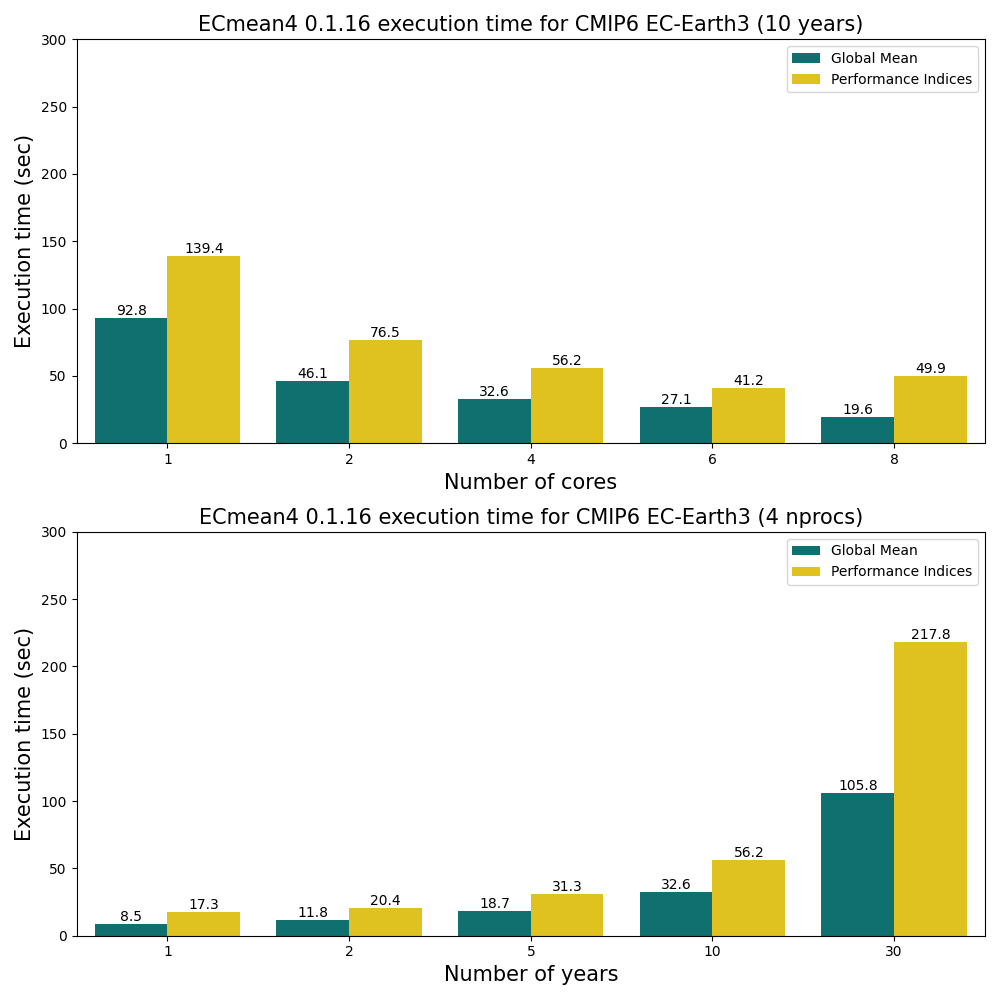
A multi-core (upper panel) and multi-year (lower-panel) benchmarking for Global Mean and Performance Indices for CMIP6 EC-Earth3 historical data
Note
So far we cannot completely exploit Dask’s full potential due to the adoption of the multiprocessing library to work along variables. This issue will be addressed in a future release, but so far the dask scheduler is set to synchronous with dask.config.set(scheduler="synchronous").
Warning
Please do not use more cores than available variables: this might lead to code crash due to a limitation of multiprocessing. See the corresponding GitHub issue .
How to cite
ECmean is distributed via GitHub and PyPI and released under the Apache License, version 2.0. Citation of the software DOI is kindly requested upon use:
Davini, & J. von Hardenberg. (2024). ecmean: a lightweight climate model evaluation tool. Zenodo. https://doi.org/10.5281/zenodo.13834628
Or alternatively, in bibtex format:
@software{ecmean,
   author       = {Paolo Davini, Jost von Hardenberg},
   title        = {ecmean: : a lightweight climate model evaluation tool},
   year         = {2024},
   doi          = {10.5281/zenodo.13834627},
   url          = {https://github.com/ecmean/ecmean},
   howpublished = {\url{https://doi.org/10.5281/zenodo.13834627}},
   note         = {Open-source software}
}